
Meta's stock price experienced a significant surge after the company outperformed Q1 2025 earnings expectations. Revenue climbed 16% year-over-year to $42.3 billion, surpassing the $41.4 billion forecast. Earnings per share reached $6.43, exceeding the expected $5.22. Additionally, net income rose sharply by 35%, hitting $16.64 billion compared to $12.37 billion a year earlier. These results reflect strong execution of Meta's strategic initiatives, boosting investor confidence in the company's growth potential and resilience within the competitive tech sector, ultimately driving the meta stock price higher.
Key Takeaways
- Meta made more money than expected in Q1 2025. Revenue grew 16% to $42.3 billion, and earnings per share hit $6.43.
- These good results made investors happy. Meta's stock price went up 5% after the news.
- Meta uses AI to improve ads, helping ad revenue grow 16% to $41.4 billion. This shows Meta can compete well in the market.
- Even with problems like rules and rivals, Meta's spending on AI and the metaverse could help it grow for years.
- More people use Meta every day, with 3.43 billion daily users. New platforms like Threads are growing fast, showing users are very active.
Key Drivers of Meta Stock Price Surge

Revenue growth and earnings per share (EPS) performance
Meta's Q1 2025 results showcased remarkable financial growth, driven by a 16% year-over-year increase in revenue to $42.31 billion. This performance exceeded analyst expectations, which had forecasted $41.4 billion. Earnings per share (EPS) also demonstrated significant improvement, reaching $6.43, surpassing the predicted $5.22. The company's operating margin rose to 41%, up from 38% in the previous year, reflecting enhanced operational efficiency.
Meta's ability to achieve these results highlights its robust business model and effective cost management strategies. The growth in revenue and EPS underscores the company's capacity to capitalize on market opportunities while maintaining profitability.
Stock price movement after Q1 earnings announcement
Following the announcement of its Q1 2025 earnings, Meta's stock price experienced a notable 5% increase. This upward movement reflects investor confidence in the company's financial health and strategic direction. Key metrics such as free cash flow of $10.3 billion and cash reserves of $70.2 billion further solidified Meta's strong financial position.
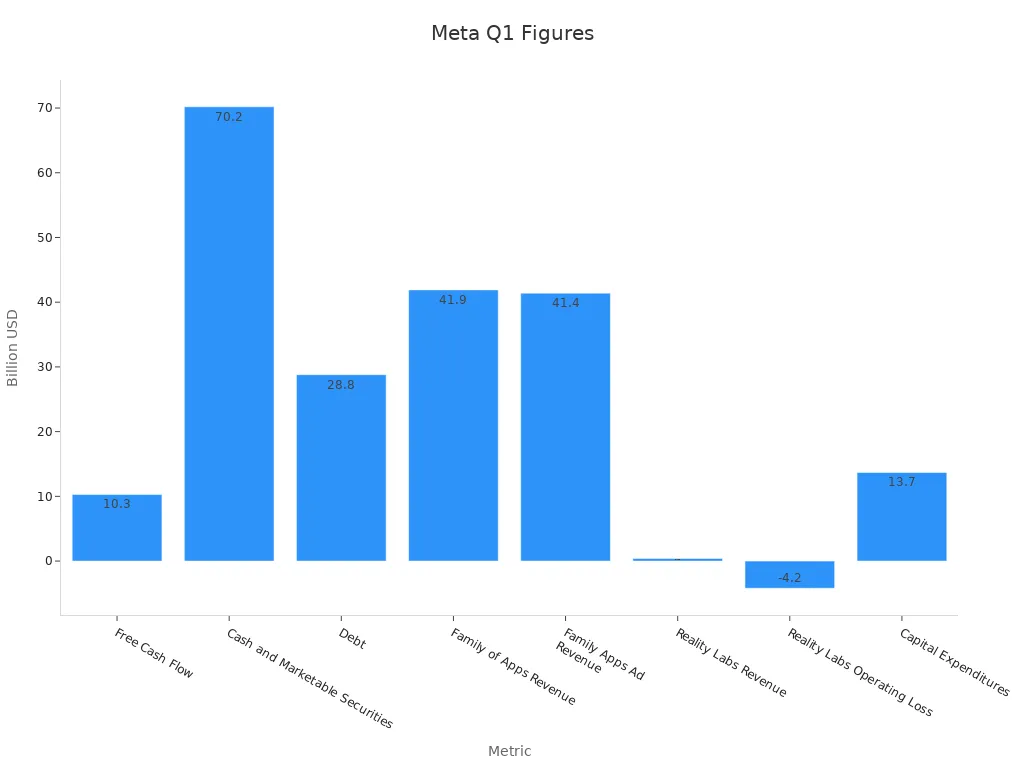
The Family of Apps segment, which includes platforms like Facebook and Instagram, contributed significantly to this growth. Revenue from this segment rose by 16% year-over-year to $41.9 billion, while ad revenue reached $41.4 billion. However, the Reality Labs division reported a 6% decline in revenue, with an operating loss of $4.2 billion. Despite this, the overall positive performance of Meta's core business segments drove the meta stock price higher.
Analyst expectations versus actual performance
Meta's Q1 2025 performance exceeded analyst expectations across multiple key metrics. Revenue outpaced predictions by $950 million, while GAAP earnings per share surpassed forecasts by $1.21. Adjusted EPS surged by 37%, reflecting the company's ability to deliver consistent growth despite a challenging macroeconomic environment.
- GAAP earnings per share: $6.43 (exceeded forecasts by $1.21)
- Revenue: $42.31 billion (outpaced predictions by $950 million)
- Adjusted EPS: Increased by 37% to $6.43
The strong results prompted 12 top-rated analysts to issue Buy ratings for Meta stock. This positive sentiment among analysts further reinforced investor confidence, contributing to the upward trajectory of the meta stock price.
Market Context and Competitive Landscape
Broader economic factors influencing tech stocks
The performance of tech stocks remains closely tied to macroeconomic indicators. Recent data revealed a rise in weekly jobless claims to 241,000, surpassing expectations and signaling potential economic instability. A surprising contraction in GDP by 0.3% during Q1 further highlights weakening growth conditions. These factors have raised concerns about a looming recession, which could dampen investor sentiment across the tech sector.
Additionally, the correlation between Bitcoin and Nasdaq stocks has strengthened, reflecting heightened sensitivity to market volatility. Investors are increasingly cautious, balancing optimism from strong earnings reports with fears of broader economic challenges. Companies like Meta and Microsoft have delivered robust results, boosting confidence in the tech industry’s resilience despite mixed macroeconomic signals.
Trends in digital advertising and Meta's resilience
Digital advertising continues to evolve as a critical revenue driver for tech companies. Meta has demonstrated remarkable resilience in this space, with ad revenue climbing 16% year-over-year to $41.4 billion in Q1 2025. This growth underscores the company’s ability to adapt to shifting advertiser demands and leverage its vast user base across platforms like Facebook and Instagram.
Meta’s focus on AI-powered ad targeting has enhanced campaign effectiveness, attracting advertisers seeking higher returns on investment. While privacy concerns and regulatory scrutiny pose challenges, Meta’s innovative strategies have positioned it as a leader in digital advertising. The company’s ability to maintain strong ad revenue growth amidst economic uncertainty highlights its competitive edge.
Comparison to other major tech companies' Q1 results
Meta’s Q1 performance stands out among its peers in the tech sector. Microsoft reported a 14% increase in revenue, driven by growth in its cloud computing division. Alphabet, however, faced slower growth, with ad revenue rising only 8% year-over-year. Apple’s Q1 results showed a modest 5% revenue increase, reflecting challenges in hardware sales.
Meta’s 16% revenue growth and 35% net income surge outpaced these competitors, solidifying its position as a top performer. The company’s strategic investments in AI and digital advertising have enabled it to capitalize on market opportunities, setting it apart in a competitive landscape.
Future Growth and Strategic Investments
Meta's Q2 guidance and revenue projections
Meta's Q2 2025 revenue guidance reflects optimism despite broader economic uncertainties. The company projects revenue between $42.5 billion and $45.5 billion, marking a year-over-year increase of 8.8% to 16.5%. Analysts anticipate an average sales figure of $43.81 billion for the quarter. This forecast includes a 1% benefit from foreign currency fluctuations, highlighting Meta's ability to navigate global market dynamics effectively.
The guidance underscores Meta's resilience in the face of fluctuating ad spending trends, particularly a noted decline from Asian e-commerce retailers in April. Despite these challenges, the company’s healthy revenue trajectory demonstrates its capacity to adapt and maintain growth momentum. Investors view this outlook as a testament to Meta's robust operational strategies and its ability to deliver consistent performance.
Increased capital expenditures and AI-driven initiatives
Meta's commitment to innovation is evident in its increased capital expenditure projections for 2025. The company now estimates spending between $64 billion and $72 billion, up from an earlier range of $60 billion to $65 billion. This investment supports the development of AI infrastructure, which has already yielded significant results. Advancements in AI have improved ad targeting capabilities, leading to a 10% increase in the average price per ad. This enhancement reflects Meta's ability to leverage technology to drive advertising performance and revenue growth.
The company’s focus on AI extends beyond advertising. Meta plans to deploy its AI assistant to nearly a billion monthly active users, aiming to enhance user engagement across its platforms. This strategic move aligns with industry trends, where major tech companies are ramping up AI investments to gain a competitive edge. Meta's proactive approach positions it as a leader in the AI space, reinforcing investor confidence in its long-term growth strategy.
Long-term potential of the metaverse and innovation
Meta continues to prioritize the metaverse as a cornerstone of its long-term vision. While Reality Labs reported a $4.2 billion loss in Q1 2025, cumulative losses exceeding $60 billion since 2020 highlight the scale of Meta's investment in this transformative initiative. The company remains steadfast in its belief that the metaverse will redefine digital interaction and unlock new revenue streams.
High capital expenditures, ranging from $64 billion to $72 billion, further emphasize Meta's dedication to innovation. These funds support AI infrastructure and metaverse development, ensuring the company remains at the forefront of technological advancements. However, Meta faces stiff competition from platforms like TikTok, YouTube, and Snap, as well as AI-focused companies such as Microsoft and Google. Despite these challenges, Meta's strategic investments and vision for the metaverse position it as a key player in shaping the future of digital experiences.
Meta's ability to balance short-term profitability with long-term innovation underscores its potential for sustained growth. By integrating AI and metaverse technologies, the company aims to enhance user engagement, drive revenue, and maintain its competitive edge in an evolving market.
User Growth and Engagement Metrics

Daily active users (DAUs) and monthly active users (MAUs)
Meta's platforms demonstrated impressive user growth in Q1 2025. The company reported 3.43 billion daily active people (DAP), reflecting a 6% year-over-year increase. This figure includes users across Facebook, Instagram, WhatsApp, and Messenger. Threads, Meta's emerging social platform, achieved remarkable growth, reaching 350 million monthly active users (MAUs). This represents a 267% increase from 100 million MAUs in Q1 2024.
- Threads: 350 million MAUs (267% increase year-over-year)
- Core apps (Facebook, Instagram, WhatsApp, Messenger): 3.43 billion DAP (6% increase year-over-year)
Threads' rapid expansion highlights Meta's ability to attract and retain users on new platforms. Despite competition from platforms like X, which claims 600 million MAUs, Meta's ecosystem continues to grow, reinforcing its dominance in the social media landscape.
Engagement trends across Meta's platforms
User engagement across Meta's platforms remains robust. The integration of AI-driven features has enhanced user experiences, leading to higher interaction rates. For instance, AI-powered recommendations on Facebook and Instagram have increased time spent on these platforms. Messaging services like WhatsApp and Messenger also saw a surge in activity, driven by new features such as business messaging and payment integrations.
Meta's focus on short-form video content, particularly through Instagram Reels, has further boosted engagement. Reels now account for a significant portion of time spent on Instagram, attracting both users and advertisers. These trends underscore Meta's ability to adapt to shifting user preferences and maintain high engagement levels.
Growth in emerging markets and monetization strategies
Meta's expansion in emerging markets has been a key driver of user growth. The company has focused on improving accessibility and connectivity in regions with limited internet infrastructure. This strategy has resulted in increased adoption of Meta's platforms in countries across Asia, Africa, and Latin America.
Advertising remains Meta's primary revenue driver, with a 16% year-over-year increase. This growth was supported by a 5% rise in ad impressions and a 10% increase in the average price per ad. Investments in AI have also created new monetization opportunities, with nearly 1 billion monthly active users engaging with Meta AI. These efforts highlight Meta's ability to capitalize on emerging markets while diversifying its revenue streams.
Challenges and Risks
Regulatory scrutiny and legal challenges
Meta faces increasing regulatory scrutiny and legal challenges as governments and organizations worldwide tighten oversight of tech companies. Copyright lawsuits have emerged as a significant concern, with authors and publishers accusing Meta of using their works without authorization for AI training. European regulators have raised alarms over the extensive use of personal data in AI systems, citing privacy risks. Competition law investigations are underway to determine whether Meta's data advantages stifle innovation and hinder fair competition in the AI market.
Emerging regulations, such as the EU's AI Act, are expected to impose compliance costs and operational restrictions on AI applications. These developments could impact Meta's ability to scale its AI-driven initiatives effectively.
Privacy concerns and their impact on advertising revenue
Privacy concerns continue to challenge Meta's advertising model. Users and regulators have expressed apprehension over the collection and use of personal data for targeted advertising. Stricter privacy laws, such as the General Data Protection Regulation (GDPR) in Europe, have forced Meta to adapt its practices, often at the expense of advertising efficiency.
The company’s reliance on AI-powered ad targeting has drawn criticism for its potential misuse of sensitive user information. These concerns could lead to reduced advertiser trust and lower ad spending, impacting revenue growth. Meta's ability to balance privacy compliance with effective ad targeting remains critical to sustaining its competitive edge in the digital advertising space.
Competition from other tech and social media platforms
Meta operates in a fiercely competitive landscape, facing challenges from both established players and emerging platforms. Companies like TikTok, YouTube, and Snap continue to attract younger audiences, threatening Meta's dominance in social media. In the AI domain, rivals such as Microsoft and Google are investing heavily in infrastructure and innovation, intensifying competition.
Despite these challenges, Meta's financial metrics highlight its strong position relative to industry averages. The company boasts a higher return on equity (12.0% vs. 7.41%) and revenue growth (20.63% vs. 5.32%), showcasing its ability to outperform competitors. However, Meta's elevated price-to-book and price-to-sales ratios suggest potential overvaluation, which could deter investors in the long term.
Meta's ability to innovate and adapt will determine its success in navigating these competitive pressures.
Meta's Q1 2025 performance underscores its ability to deliver consistent growth and innovation. Key achievements include a 16% revenue increase, a 6% rise in daily active users, and a 10% boost in ad pricing. These metrics reflect the success of Meta's strategic investments in AI and digital advertising. Analysts project an average target price of $703.27, suggesting a 28.10% upside for the meta stock price. Despite challenges like a $5 billion loss in Reality Labs, Meta's focus on user engagement and technological advancements positions it for sustained growth in a competitive market.
FAQ
What caused Meta's stock price to rise after Q1 2025 earnings?
Meta's stock price increased due to strong Q1 2025 financial results. Revenue grew by 16%, and earnings per share exceeded analyst expectations. These metrics, combined with strategic investments in AI and digital advertising, boosted investor confidence and drove the stock price higher.
How does Meta's performance compare to its competitors?
Meta outperformed competitors like Alphabet and Apple in Q1 2025. Its 16% revenue growth and 35% net income increase surpassed the industry average. Strategic investments in AI and digital advertising gave Meta a competitive edge, solidifying its position as a top performer in the tech sector.
What role does AI play in Meta's growth strategy?
AI plays a pivotal role in Meta's growth. It enhances ad targeting, increasing ad revenue by 16%. AI-powered features also improve user engagement across platforms. Meta's investment in AI infrastructure positions the company as a leader in innovation, driving both short-term and long-term growth.
What challenges does Meta face in maintaining its growth?
Meta faces challenges like regulatory scrutiny, privacy concerns, and competition from platforms like TikTok and YouTube. Stricter privacy laws and emerging AI regulations could impact operations. Despite these risks, Meta's strong financial position and innovative strategies help mitigate potential setbacks.
How is Meta expanding in emerging markets?
Meta focuses on improving accessibility and connectivity in emerging markets. This strategy has driven user growth in regions like Asia, Africa, and Latin America. Increased adoption of Meta's platforms in these areas supports revenue growth and diversifies the company's global user base.



0 Comments